Last week's question: what are the fluid dynamics of drafting?
Drafting is the practice of staying behind another moving object to reduce the energy needed to move. This is possible because when air moves past an object, there is a small area behind said object where the air cannot reform as rapidly, creating an area of low pressure. This low pressure is filled by pulling nearby particles, including those of the following object, towards it, hence saving energy on the following object's part.
Despite this somewhat technical explanation, I can't see to find fluid flow diagrams of drafting. Maybe someone would be so kind as to provide one?
This week's question: How are the stone arches in Arches National Park and elsewhere formed?
Smile!
Unknown, 2009-03-27
I had this conversation more than once with a GSW student this quarter:
My dad has always had this work/play distinction. This is a quote from an actual email he sent me:

And Feynman:
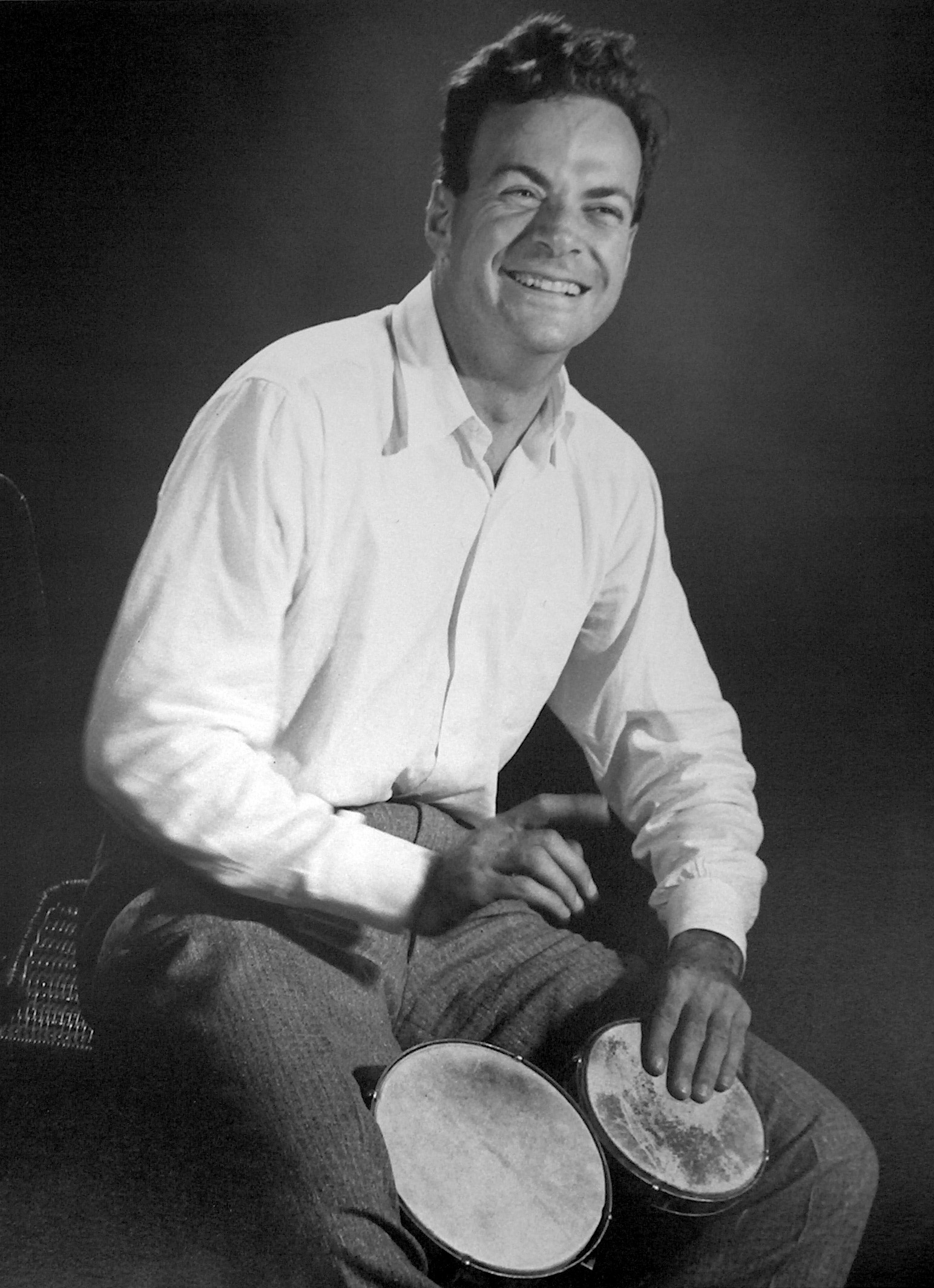
who played the bongo drums. He also said to People magazine after getting his Nobel prize, "If I could explain it to the average person, I wouldn't have been worth the Nobel Prize." Nuts.
In fact, Freeman Dyson thought being funny is highly related to these two's fame:
To drive home the point, here's a TED talk by Stuart Brown on why play is vital.
Her [working on the problem, looking up to see me smiling]: What? What are you smiling at?This is becoming truer and truer over time. I don't literally smile all the time, but I see humor in a lot of things. Even if people who smile don't do so well in life, they tend to have more fun... which is the point, right?
Me: I'm not laughing at you. I smile at everything.
My dad has always had this work/play distinction. This is a quote from an actual email he sent me:
Sometimes, I ask myself, am I a bit selfish? Many people start working for charity after retirement - to continue to use their knowledge and experience to help the society grow, and to help the under-privileged people. On the other hand, I think that I have also spent the last 30 years actively involved in the building and managing an excellent railway for the people of Hong Kong. Considering that I work 12 to 14 hours a day, I think I have worked for 45 years already, based on an 8-hour day. I think I have done my part and I do not owe the society anything. Any extra effort must be extra. Should I start playing now, do the things I like to do, reserve the remaining time of my life to myself and spend the time with the people around me? I do not mind doing some volunteer work, but it must not be "work".We often had semi-philosophical discussions like this, so it wasn't surprising. I wrote back,
The above may seem far-reaching to you. As you know, I always adopt the value of "Work Hard, Play Hard". Work must come first. If I do not work hard in my younger days, I cannot figure out how I can play hard. I may not even have the money for you and your brother to attend an international school and study abroad! Having said all these, I am not asking you to take me as an example. You should always balance working and playing, although still giving "work" the priority. Does that make sense?
About working: you know I've always had a different view. Working should be playing, damn it. Yes you should spent time hiking, running, or something that makes you happy, but why shouldn't working make you happy too? I'm teaching this quarter, and I get paid $400 a quarter. I enjoy teaching, and I enjoy watching people learn. If I didn't, I probably wouldn't have applied for the job in the first place. So yes, "work hard, play hard," but preferably "at the same time."Besides, the most famous scientists all had a great sense of humor. Einstein:
And Feynman:
who played the bongo drums. He also said to People magazine after getting his Nobel prize, "If I could explain it to the average person, I wouldn't have been worth the Nobel Prize." Nuts.
In fact, Freeman Dyson thought being funny is highly related to these two's fame:
Scientists who become icons must not only be geniuses but also performers, playing to the crowd and enjoying public acclaim. Einstein and Feynman both grumbled about the newspaper and radio reporters who invaded their privacy, but both gave the reporters what the public wanted, sharp and witty remarks that would make good headlines. Hawking in his unique way also enjoys the public adulation that his triumph over physical obstacles has earned for him.Really the important thing, I think, is making your work fun. I totally agree with Paul Graham, who's essay How to Do What You Love I've referenced ad nauseum. With academia it's easy - I won't go into a field I didn't like anyway.
To drive home the point, here's a TED talk by Stuart Brown on why play is vital.


Drafting
Unknown, 2009-03-23
Last week's question: Why do things appear smaller when they are further away?
This intriguing problem actually has very little discussion. I found several discussion boards, but the people on there are either really confused or half crazy. The last link is the best explanation, although it was also touched on in the other discussion boards.
But in any case, I figured out the solution before reading the boards. It's nice to have my answers checked though.
What happens is that as objects are further away, the angle it forms in our eyes is smaller. All the light has to pass through a small hole (the pupil for the human eye, some other form of lens for cameras and video recorders) before this gets processed. The larger the angle, the larger than image is. When an object is up close, light from that object forms a very obtuse angle. This translates to a large image. When things are further, however, the angle is smaller. This correspondingly makes the image smaller.
The second part of the question was why this was the case. This is the case because light travels in a straight line. If light curved before entering recording device to make a bigger angle, or otherwise curved after that point and before it hits the retina, then closer objects could appear smaller than large ones. But our vision would also be greatly distorted.
In fact, I wonder if there are animals whose eyes work like this.
This week's question: What are the fluid dynamics of drafting in cycling or driving?
Trains and Skip Lists
Unknown, 2009-03-20
I was on the El to the airport the other day (for my Michigan visit, actually), and I was wondering how the train system could be improved. Someone once suggested that the network should be built like a spider web centered around down town Chicago. There would be trains which take you down town, but also other lines which circle the city. A line like that would certainly make the trip from Evanston to O'Hare a lot shorter, but it's a costly way to make the train system efficient.
Instead, as a nerd computer scientist, I thought about how trains are kind of like linked lists. You start at some node, but to get to another node you have to go through everything that's in between. This is, of course, as opposed to arrays, where you can just jump to the node you need.
And then I realized, people have solved this problem in computer science before. The solution: skip lists. These are not data structures normally taught in courses (although I heard that has changed since I took it... sigh), but the principle it functions on is simple. Going with the train analogy (and only going one way for the moment), instead of having one train stop at every station, you have several trains/tracks. One would stop at every station, another would stop at every other station, then every fourth, eighth, and so on. Getting to your destination would then involve transferring to trains that skip more and more stations, stay on that train until its next stop is past yours, then transfer to slower and slower trains.
Of course, this idea is not new to transportation companies either. Usually it's given the name "express". The only difference is that the express tends only to run during rush hours, and not otherwise. That is understandable - if there aren't that many passengers, profit will be low or even non-existent if there are several trains going around rather than just one.
And yet, the tracks are already there. Between Howard and Fullerton the Red and Purple Lines run on separate tracks. They don't stop at the same stations (except Belmont), but the tracks are there for this to happen.
So here's what I suggest. Instead of doing the whole skip-2, skip-4, skip-8 system, which would require a separate track for each train, just use two tracks. Have the express do a skip-4 or something otherwise in the middle. The express will then travel roughly 4 times faster than the normal train, greatly speeding up travel. At the end of each track, just do a merge to change sides, and the trains are ready to go back.
Unfortunately, in the current economic climate no one will do this. It's probably prohibitively expensive, and will never get enough passengers. And the space to get 4 tracks (2 there and 2 back) is also pricey. But it looks good on paper!
And that is how computer science (tries to) impact real life.
Car Seating
Unknown, 2009-03-18
We have 19 people going on spring break, including myself. I've been thinking about how to organize people in the three vans, and came up with this:

A legend is available, although I did not show the single arrow relations... :D
The problem is that only the people in blue and red are drivers, and the people in red each own one of the vans (and therefore must be in separate cars). The drivers should split evenly between the three cars. I also tried to maintain the male:female ratio in each car.
I assigned points to the relationships (1 to acquaintances, 2 to friends, 4 to boy/girl friends), and derived this:

Clearly the current solution is better than the old one (by a whole 8 points!).
This problem is NP-complete, and while I could write an algorithm to exhaustively search the space of possible allocations,
I am open to better solutions.

A legend is available, although I did not show the single arrow relations... :D
The problem is that only the people in blue and red are drivers, and the people in red each own one of the vans (and therefore must be in separate cars). The drivers should split evenly between the three cars. I also tried to maintain the male:female ratio in each car.
I assigned points to the relationships (1 to acquaintances, 2 to friends, 4 to boy/girl friends), and derived this:

Clearly the current solution is better than the old one (by a whole 8 points!).
This problem is NP-complete, and while I could write an algorithm to exhaustively search the space of possible allocations,
- It's probably tedious, especially with the male:female constraints
- I don't feel like it
- I think this is a near optimal solution (read: good enough).
I am open to better solutions.
Distance Perception
Unknown, 2009-03-16
Last week's question: How often does square root day, and other higher order root days, occur?
Because of the way square root day is done (and written in general culture), there are only nine square root days in each century. This boils down to a square root day on average every 11 years.
I read a blog post with more interesting interpretations of dates.
If dates were written 3-3-09, then one person commented that 3 and -3 are both roots of 9. It is unfortunate that the is a dash before the year - because it should more properly be 3i-3i-09.
A more momentuous day, a commenter suggested, is 2/2/2008, which could be called "cube root day", because 2*2*2 = 2^3 = 8. But no one ever takes apart the year like that.
My personal favorite is rather than celebrate square root day, we should celebrate exponent day. This occurs whenever the month taken to the power of the date gives the year. While this is a more general holiday, it doesn't occur very frequently either, because the exponential quickly goes above 100. Dates raised to the month power works slightly better.
The list of month^date=year is below:
- 01/01/01
- 02/01/02
- 03/01/03
- 02/02/04
- 04/01/04
- 05/01/05
- 06/01/06
- 07/01/07
- 02/03/08
- 08/01/08
- 03/02/09
- 03/03/09 [EDIT: clearly I do not know how to do math]
- 09/01/09
- 10/01/10
- 11/01/11
- 12/01/12
- 02/04/16
- 04/02/16
- 05/02/25
- 03/03/27
- 02/05/32
- 06/02/36
- 07/02/49
- 02/06/64
- 04/03/64
- 08/02/64
- 03/04/81
- 09/02/81
Subscribe to:
Posts
(
Atom
)